
Practice Games for Beginner Pupils
Back to music lessons means back to music practice. A dreaded word by some students, a cherished one by others. Then again, what does it mean to practice your musical instrument?
My understanding of the term has evolved from playing to remember to play to enjoy. Imagine learning your times tables once and never revising them again? I doubt many people would remember them or enjoy doing maths problems without knowing them. Practising a musical instrument is similar because it helps you develop instrumental skills, consolidate your theoretical understanding and promotes creativity and self-expression through musical performance. If you don’t play scales or pieces between lessons, your love for the instrument might start to fade. You won’t be able to move onto new material and you might miss out on opportunities to listen, learn and grow as a musician.
So, what can we do as teachers and parents to induce some much-needed enjoyment into practicing? Play games!
Teaching piano and flute to hundreds of students across London has highlighted the importance of keeping play central to instrumental tuition. As a result, I play these practice games in lessons with my pupils and encourage them to incorporate these into their weekly practice sessions. I would encourage you to experiment as the year commences and devise your own as a result.
1. Crossing the Bridge
A short game involving repetitions with a twist.
Materials Needed
3 objects that are small enough to fit on a music stand or edge of a keyboard.
Instructions
- Place 3 small objects on the left-hand side of your music stand or keyboard e.g. bracelets, erasers or pencils.
- Select a goal for a particular piece and say it out loud e.g. "I'm going to play Bar 1 to 6 of Berry’s Smoothie without stopping.
- Play your chosen section of the piece.
- Move Object No. 1 to the right-hand side of the music stand/ keyboard if you achieve your goal.
- Repeat the passage.
- Move Object No. 2 to the right if you achieve your goal. Return Object No. 1 to the left if you make a mistake.
- Continue until all 3 items have crossed to the right-hand side of the "bridge."
2. Soft Toy Tuition
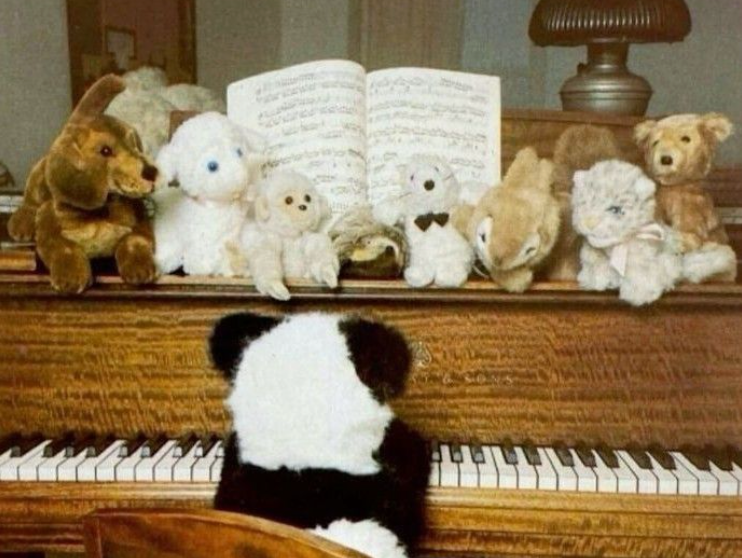
Get Bunny and all their friends to be the audience of your child’s performance.
A firm favourite with my beginner pupils. It can be particularly useful when students are struggling to regulate their emotions in lessons or practice sessions.
Materials Required
A soft toy preferably with long arms and legs.
Instructions
- Put your soft toy next to your music stand or keyboard.
- Select a section from your student/child’s piece e.g. Bar 5-8 of Rigadoon.
- Show the soft toy how to play this section of the piece. This could involve playing the finger patterns on a woodwind/brass instrument or pressing the correct keys on a piano with their paws. Repeat several times.
- “Ask” the soft toy to be an audience member while your student/child “performs” the same section for their “practice assistant.”
3. AMP (Adagio-Moderato-Presto)
An important practice technique for students struggling to play pieces at different speeds. Use Stage 1 with pupils who have not used a metronome in lessons and/or practice sessions.
Materials Required
Stage 2 will require a metronome.
Instructions
Stage 1
- Select a section of your child/student’s piece.
- Play this passage Adagio.
- Perform the same section Moderato.
- Play these measures Presto.
Stage 2
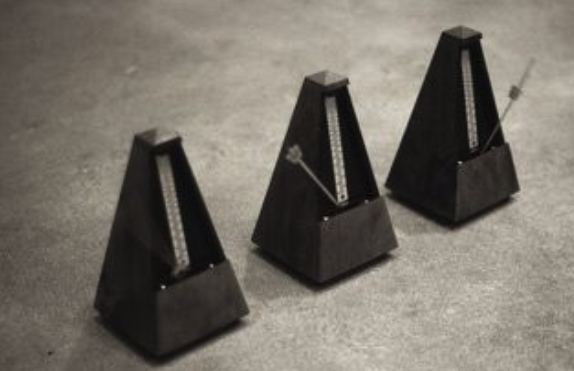
metronome
- Choose a comfortable tempo.
- Play your chosen section at this speed with a metronome.
- Increase the tempo by 5 bpm. Play the passage again.
- Repeat the above step.
- Return to the previous speed if you make a mistake.
- Continue until your child/pupil can play the section at a suitable tempo.
Note: BPM = Beats per Minute
4. Tappin Time
Materials Required
Enthusiasm😊
Instructions
Option A: string, woodwind and brass instruments.
- Select 4-8 bars from a piece your student/child is working on e.g. Bar 3-6 of Sakura.
- Clap the rhythm steadily.
- Tap the rhythm steadily.
- Clap the rhythm with your child/student.
- Play the rhythm on a note of your choice e.g. C.
- Play as written.
Option B: piano players.
- Clap the rhythm of the right hand.
- Clap the rhythm of the left hand.
- Tap the rhythm of both hands together.
- Play the rhythm on 2 repeated notes e.g. RH plays G G G G while LH plays C C C C in the correct rhythm.
- Perform this section as written.
5. Dancing Dice
An excellent practice game to encourage pupils to start their pieces in different places.
Materials Required
A die (one dice) from a board game.
Instructions
- Place the die (one dice) next to your keyboard or music stand.
- Write the number 1, 2, 3, 4, 5 and 6 above different bars in your music. Number 1 should be at the beginning and number 6 should be near the end. Teachers should be able to assist with this if the need arises.
- Roll the die.
- Play from the number shown on the dice to the end of the piece.
- Repeat several times.
Happy practicing😊
BY SERENA SHEANE BMUS ATCL